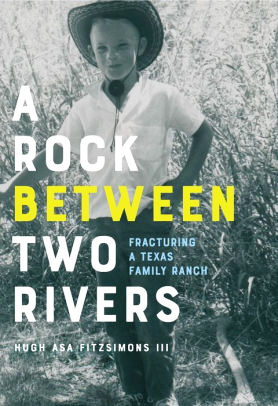
Many Texas ranchers have a special bond with their land: they grew up on it; inherited it from a parent or other relative; earned their livelihood from its huge acreage; and hope to pass it on, after their demise, as a loving legacy for their children or grandchildren.
The hope, as Hugh Asa Fitzsimons III makes clear in his engrossing and important new book, A Rock Between Two Rivers: Fracturing a Texas Family Ranch, is that the inheritors will keep the ranch going and pass it on again—along with their love for ranching—to the next generation.
But a ranch, its money-generating operations, and its land parcels, sometimes can become economic and emotional flashpoints among siblings and others. They can’t agree on how the legacy should be divided, or some want to sell their shares because they don’t want to be ranchers. And others may give in to greed and sue their kin, seeking control or more shares.
In short, a ranch can fracture a family, and the rifts can become even wider if the land has been opened to oil and gas drilling and fracking as an additional way to help keep the ranch profitable.
Fitzsimons, a Dimmitt County rancher, found himself in this situation after his father died and other family members disagreed with the author’s desire to disallow oil drilling or fracking on his portion of the San Pedro Ranch. In an arid area where rain was rare, he realized that fracking — “the last gasp of a dying industry” — threatened the very aquifer that kept his family’s ranch and others alive.
“Our precious water,” he writes, “was being mined, extracted from our aquifer, and then injected along with a chemical cocktail of toxic carcinogens into the Eagle Ford shale below. This liquid-and-sand mix explodes and fractures the shale rock. If done correctly and with precision, the frack stays where the engineer wants it to go. But a dip in the formation and an unexpected turn thousands of feet below the surface can lead to disaster and the contamination of your fresh water.”
Fitzsimons cautions: “It’s only a matter of time before this scheme implodes, leaving landowners holding the bag.”
Over family objections, Fitzsimons decided to let nature take stronger hold of his share. He replaced cattle with bison, better adapted to the dry landscape, and he began producing bison meat and wild honey on commercial levels. He also renamed his spread Shape Ranch, symbolic of shaping a new life for him and his wife, children, and grandchildren, he explains.
The complexities of long-established mineral rights, plus harmful pollutants from nearby oil and gas operations, still intercede, however. Fitzsimons recounts his battles with oil and gas companies and his complaints to the Texas Commission on Environmental Quality. In Texas, he says, relevant laws and regulatory agencies effectively add up to “little more than cheerleaders for the oil and gas industry.”
A Rock Between Two Rivers is important reading for anyone concerned about how to balance heritage and lifestyles with the stark realities of water conservation, air pollution, energy production, climate change, and protecting natural habitats.
Leave a Reply