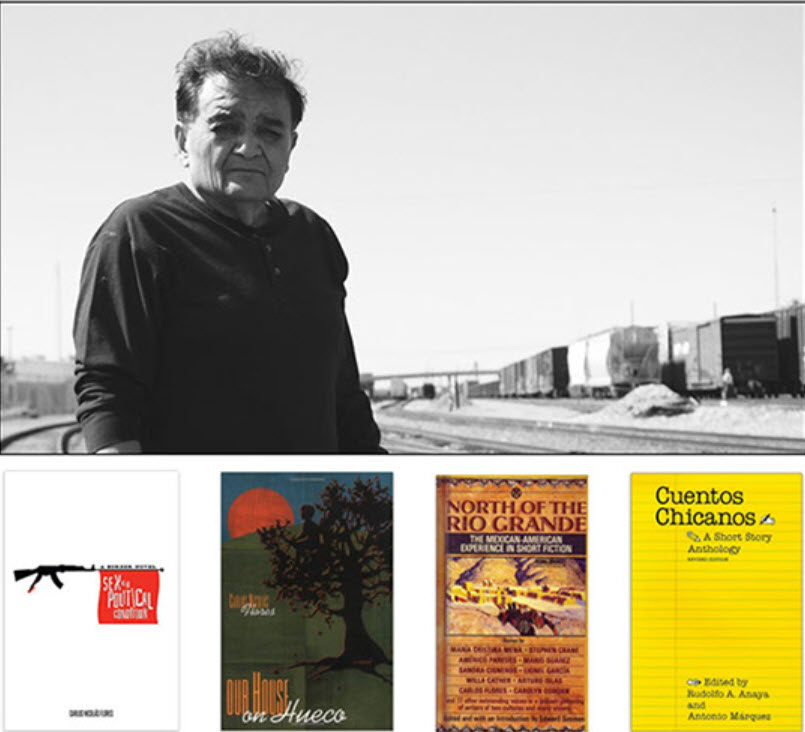
LONE STAR LITERARY LIFE: Carlos, you are the director of Teatro Chicano de Laredo (Laredo Little Theatre), an instructor at Laredo Community College, and a writer. How does each of these pursuits inform the other?
CARLOS NICOLÁS FLORES: Teaching at Laredo Community College has allowed me to live and write on the Mexican-American border. Moreover, it has provided a platform from which to launch the popular Teatro Chicano de Laredo. The work of local playwrights has deepened my understanding of the border itself, while the experience as director has provided ample material for a collection of novellas or short stories about the theater.
What inspired you to become a writer, and when did this occur?
I picked up the virus at Austin High School in El Paso, in the midst of a profound depression. My friend John Stevenson, a gifted aspiring writer, one day suggested I read Crime and Punishment by Fyodor Dostoevsky. The book was a life-changing experience. I found a way to understand and deal with despair. Meanwhile, John became a successful art dealer in New York.
In your research and studies you have traveled throughout Mexico, Guatemala, Cuba, Nicaragua, El Salvador, Greece, Turkey, Italy, Egypt, and Israel. How has travel influenced you and your writing?
I don’t understand how I could write about Latin America without having lived or travelled there. For instance, Sex as a Political Condition required trips to Guatemala, Nicaragua, and Mexico. The insights I acquired during a recent trip to Spain, Portugal, and Morocco expanded my understanding of the conflict still brewing at the heart of Mexican-Americans’ identity.
Almost ten years ago you wrote a very powerful young adult novel about the stresses and tensions of a Hispanic family. Will you share with our readers what Our House on Hueco was about? And do you think things would be different for Junior’s family today?
Our House on Hueco is a story about a Hispanic boy’s integration into the Anglo-American reality in El Paso when his father buys a house in a predominantly Anglo neighborhood. Unable to afford to pay on the mortgage, his father rents the house to an Anglo family from the military base and houses the family in the basement until they are able to annex a small apartment in the backyard. Their predicament could be considered an allegory of the relationship between Hispanics and Anglos in the Southwest; the children of many immigrants are living through a similar experience.
What writers did you read growing up, and how did they influence you?
Charles Dickens, Mark Twain, Edgar Allan Poe, Victor Hugo, George Eliot, Nathaniel Hawthorne, Emily Dickinson, Isaac Asimov, and other classics provided a solid foundation. However, it wasn’t until I encountered Dostoevsky that my passion for literature blossomed. And, I must admit, that to this day his influence has been all encompassing. His influence led me to the equally powerful William Faulkner.
Your new novel, Sex as a Political Condition, has been described as a raucous, hilarious journey into the wild, sometimes outrageous world of the Texas-Mexico border and geographical points south. What would you like our readers to know about your current book?
A young Hispanic female writer from South Texas said, “If it weren’t for the bathroom humor, Sex as Political Condition would be a truly dark tragedy, and no one would read it.” So, the bathroom humor is a rhetorical device—comic relief, if you wish—to draw and entertain readers while cushioning their encounter with the darker aspects of the reality portrayed. Another reader commented that the novel is “outlandish, offensive, and on-target” and advises that you will enjoy it if you “check your outrage at the door.”
Your website describes you as an author, professor, and Chicano activist. What is the current focus of your activism?
Throughout the years, I have involved in multiple projects, everything from launching a Chicano literary review, the Revista Rio Bravo, to the establishment of the South Texas Writing Project, an affiliate of the National Writing Project. During the last five years I directed Teatro Chicano de Laredo. Currently, I am working on the establishment of a center for Mexican-American studies at Laredo Community College.
This past summer, along with Sandra Cisneros and other noted Mexican-American writers, you published a piece in the anthology North of the Rio Grande: The Mexican American Experience in Short Fiction. Do you agree with the notion that many people do not grasp the multiplicity and complexity that exists within Latin American culture?
The late Mexican poet and essayist Octavio Paz put it best when he stated in the 1960s that while Americans live in “a monologue,” Mexicans are “gagged.” Until these two conditions change, the two cannot engage in a genuine and fruitful dialogue. Have things changed, improved? Perhaps. But we still have a long way to go.
What advice would you have for aspiring authors—and specifically for Hispanic authors?
Less than 1 percent of writers in the United States get published, and 90 percent of published writers are lucky if they sell five hundred copies of a book. At least this is what I have read or been told by publishing-industry insiders. Also, while MFA programs churn out writers by the thousands, the reading of books has declined dramatically. I advise that people think twice before succumbing to the “virus” of wanting to become a writer. As for Hispanic authors—in fact, all writers—I would suggest they serve an apprenticeship under a hard-nosed, take-no-prisoners seasoned editor or senior writer before thinking they’re ready to be published. And plan for the long run.
Your hometown, Laredo, was formed in 1755, making it one of the most historic locations in Texas. What would you like readers to know about Laredo?
Laredo, Texas, is a fascinating paradox as both a provincial city and an international one. As a result of its history and its very close ties with Nuevo Laredo, Mexico, it is probably the most “Mexican” of all the border towns. You can spend an entire lifetime here without speaking English, which enrages some “outsiders.” Like all the other towns on our southern border, it sits on one of the most controversial borders between two civilizations. For me, it has been the next best thing to living in Mexico or Europe, which I so much desired as a young man. Above all, it has been a demanding and implacable source of literary inspiration.
Leave a Reply