Lone Star Book Reviews
of Texas books appear weekly
at LoneStarLiterary.com
Jean Edward Smith was a member of the faculty at the University of Toronto for thirty-five years, and at Marshall University for twelve. He has also been a visiting scholar at Columbia, Princeton, and Georgetown. In addition to Bush, he is the author of Eisenhower in War and Peace; (winner of the 2008 Francis Parkman Prize of the Society of American Historians); Grant (a 2002 Pulitzer Prize finalist); John Marshall: Definer of a Nation; and Lucius D. Clay: An American Life.
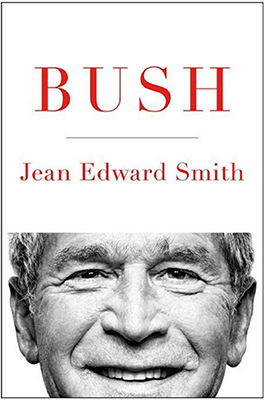
POLITICAL BIOGRAPHY
Jean Edward Smith
Simon & Schuster
Hardcover, 978-1-4767-4119-2, 832 pages,
(ebook and audio book also available)
July 5, 2016
Noted historian and biographer Jean Edward Smith tackles two politically charged questions—and much more—in this important, heavily researched life story of Texas’s forty-sixth governor and America’s forty-third president, George W. Bush.
The questions are: Was Bush “the worst president in American history,” as many partisans and pundits have charged? And, was Bush’s 2003 “decision to invade Iraq…the worst foreign policy decision ever made by an American president”?
In any presidency, it can be argued, good, bad, and sometimes very bad decisions are made in the Oval Office. Many Bush detractors have labeled the forty-third president a “yes man” for Vice President Dick Cheney, Secretary of Defense Donald Rumsfeld, and others. Smith, however, makes a strong case that President George W. Bush actually was, in most cases, “the Decider” he claimed to be.
Indeed, “W,” as he was known, often made choices based on his “religious certitude,” his “singular determination,” and his experience as Texas governor, “where he did not deal with department heads and had no executive responsibility,” Smith contends. Once he gained the considerable executive power of the White House, he often froze out the expertise and cautions of his own Cabinet members as he made a decision, Smith adds.
The biographer quotes Bush’s Secretary of State, Colin Powell, as lamenting: “Under George W. Bush, decisions seemed to come out of the ether.”
Smith pulls no punches in this hefty, revelatory biography. But he does not shy away from delivering praise, as well.
The final months of George W. Bush’s second term as president coincided with a stunningly quick meltdown of the American economy that threatened the world’s economies, too. “His decisions in 2008 to rescue Wall Street and the American automobile industry were acts of genuine courage and statesmanship,” Smith writes. “The country suffered a severe economic recession, but thanks to Bush it avoided a repeat of the Great Depression.” Smith also credits George W. Bush with having a major role in reducing U.S. and Russian nuclear arsenals, improving relations with China, expanding free trade and “almost singlehandedly lead[ing] the global fight against AIDS.”
Smith adds: “Domestically, he extended Medicare to include prescription drugs for seniors, improved educational standards with No Child Left Behind, and fought hard for immigration reform.”
But: “In 2001, he scuttled the Clinton Administration’s efforts to bring a nonnuclear North Korea back into the family of nations, and two years later led the United States into an unwarranted war with Iraq…that upset the delicate equilibrium between Shiites and Sunnis that existed in the Middle East. The casualties and the cost—estimated in excess of $3 trillion—have been disastrous.”
As for the two big questions that shape this book, Jean Edward Smith delivers compelling evidence that supports the judgments he finally renders about George Walker Bush as President of the United States.
* * * * *
Leave a Reply